
I’ve been doing SEO for over 13 years. I’ve built content sites to 500K monthly organic visits, sold one for $350k, and written SEO content for both Semrush and Ahrefs. I do SEO and AEO for the SEO tools themselves.
I also run AI visibility audits every single week across half a dozen properties. I eat, sleep, and breathe answer engine optimization (AEO). Here’s the step-by-step guide.
What Is an AI Visibility Audit?
An AI visibility audit measures how often, accurately, and favorably a brand, person, or organization is represented by AI platforms like ChatGPT, Gemini, and Perplexity. It gives you a baseline of how well you’re performing in AI search and, if done right, tells you exactly what to fix to improve your LLM visibility.
How Do You Run an AI Visibility Audit?
You can run an AI visibility audit in three steps:
- Choose prompts your potential customers actually ask
- Run those prompts through each major LLM and log the citations, mentions, and sentiment
- Turn the findings into an AEO plan
Let’s break these down.
Step 1: Choose Prompts Your Buyers Actually Ask
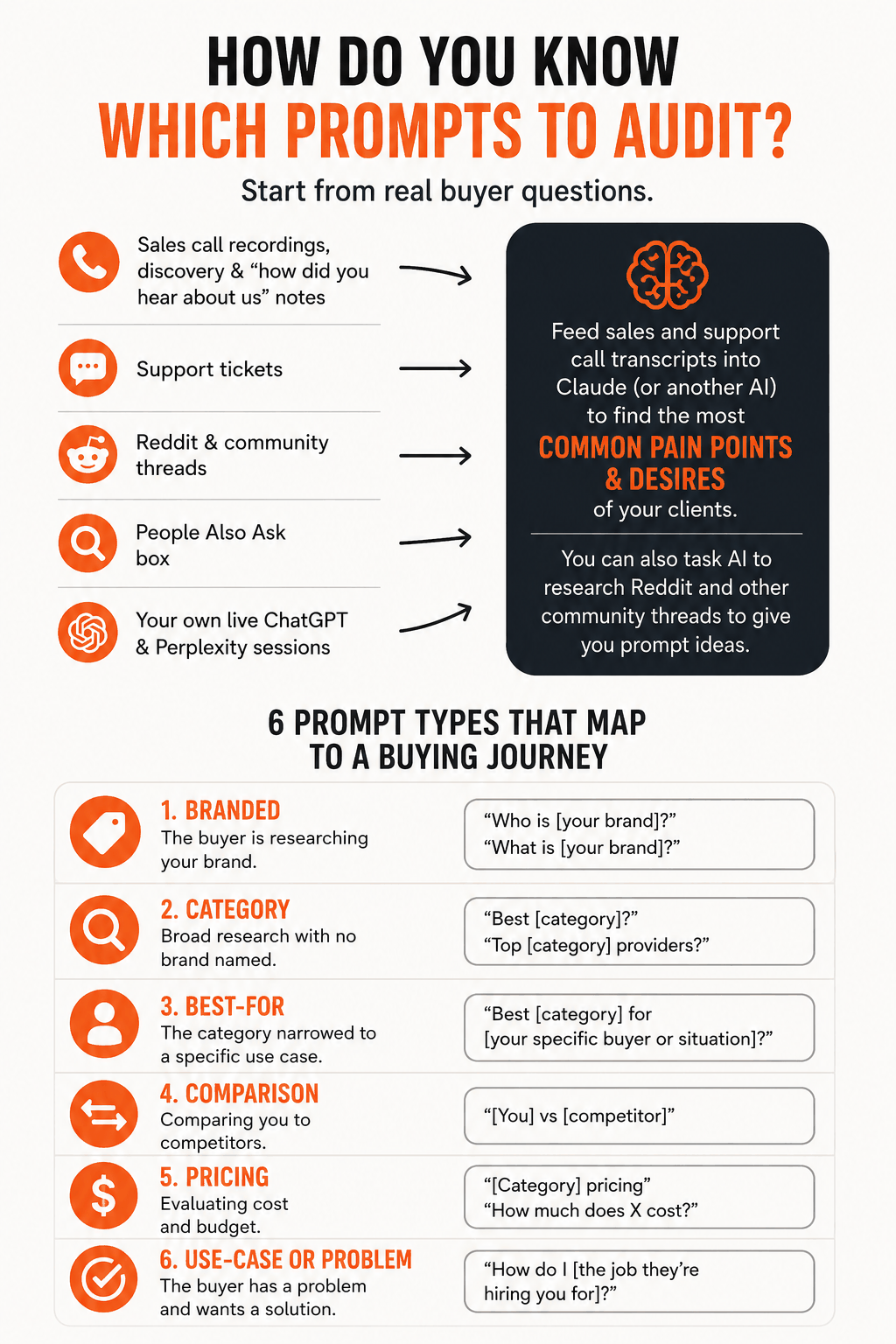
Start with real buyer questions. The prompts people type into ChatGPT are full, messy sentences, so look where your buyers actually talk: sales call recordings, discovery and “how did you hear about us” notes, support tickets, Reddit and community threads, the People Also Ask box, and your own AI chats.
I like to feed sales and support call transcripts into Claude and have it tell me the most common pain points and desires of my clients based on the calls. You can also task AI to research Reddit and other community threads to give you prompt ideas.
Cover the six prompt types that map to a buying journey:
- Branded (“who/what is [your brand]?”)
- Category (“best [category]?” or “top [category] providers?”, broad and with no brand named)
- Best-for (“best [category] for [your specific buyer or situation]?”, the category narrowed to one use case)
- Comparison (“[you] vs [competitor]”)
- Pricing (“[category] pricing” or “how much does X cost?”)
- Use-case or problem (“how do I [the job they’re hiring you for]?”)
As you’re creating your list of prompts, keep a few tips in mind:
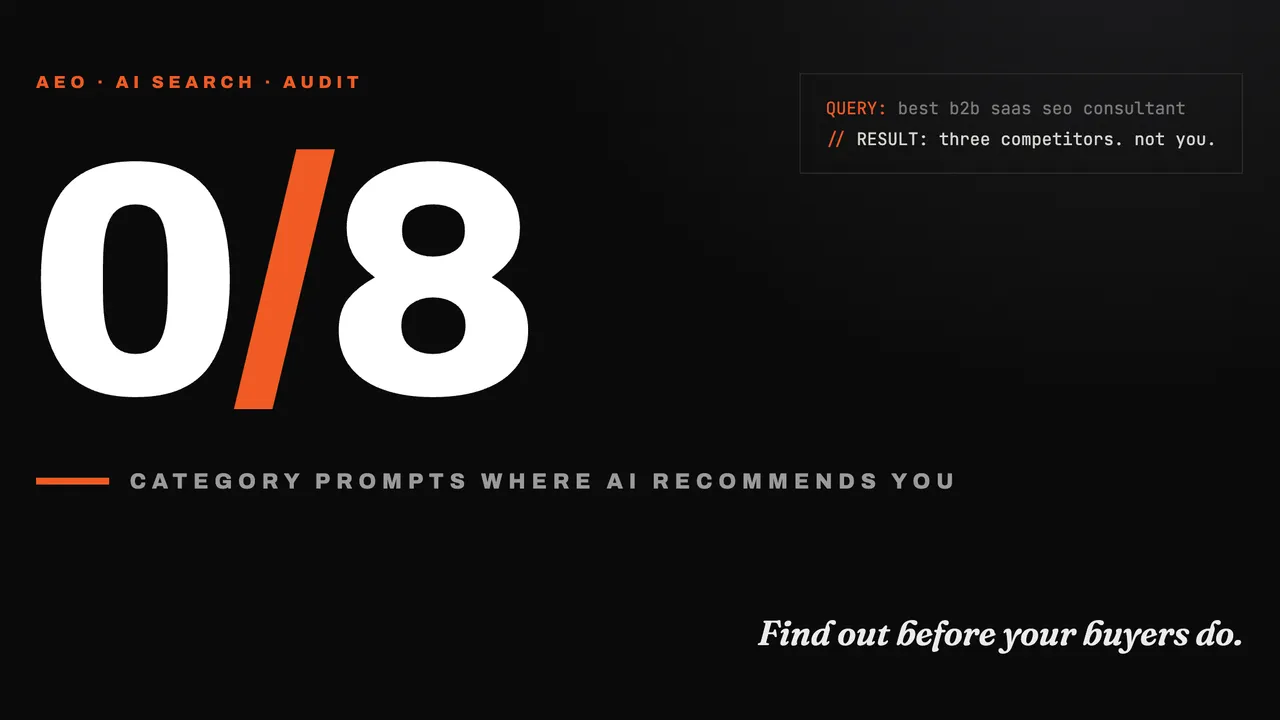
Watch for the branded vs category split. AI knowing who you are (branded) and AI recommending you to strangers (category) are completely different problems. I scored 18 to 20 of 32 on branded and 0 of 8 on category. That gap IS the AI visibility problem for most established brands.
Prioritize by intent, not volume. Comparison, best-for, and pricing prompts sit closest to a purchase, so audit those first even when the search volume looks small. That’s where citations turn into revenue, and prompt search volume is unreliable anyway.
Aim for 10 to 20 prompts. Enough for a stable read and cheap enough to track weekly. I schedule my audits to run every Sunday and judge the trend across runs, since AI responses vary from one session to the next.
Here are some of the prompts I used in my audit:
- Who is Bill Widmer?
- Who are the best AI SEO consultants for B2B SaaS companies?
- How do I get my SaaS company cited by ChatGPT and other AI tools?
- What is GEO (generative engine optimization) and do I need it?
- How do I get more AI search visibility?
- How do I measure whether AI tools like ChatGPT recommend my brand?
Step 2: Run Your Prompts Through Each LLM and Log What Comes Back
Run every prompt through ChatGPT, Gemini, Perplexity, and Claude, and log three things per answer: which URLs get cited, which brands get mentioned or recommended (you and competitors), and how accurately and favorably you’re described.
I always start with “who/what is [brand]?” and note the answer across each platform.
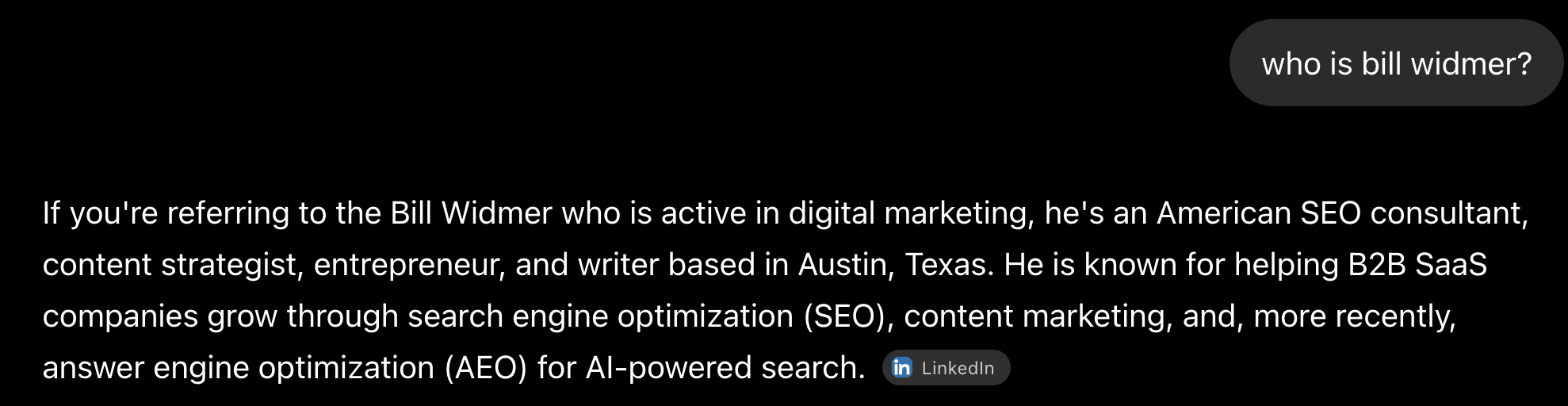
“Who/what is” prompts show you whether an AI knows you exist, how your brand is perceived, and if the AI has up-to-date and accurate information.
While you could run all your prompts manually through each LLM, it’s much easier (and faster) to use AI to help you.
I built an LLM citation tracker with Claude Code. Every week it runs the same prompts through ChatGPT, Perplexity, Claude, and Gemini, then logs the answers: which URLs get cited, whether my name comes up, and if it does, how prominently, accurately, and positively. It costs less than $1 a run.
One tradeoff to know before you build your own: a tracker like this runs on API keys, which means your prompts and results flow to every AI provider you’re testing. Fine for market-facing questions like these, but don’t pipe anything sensitive through it.
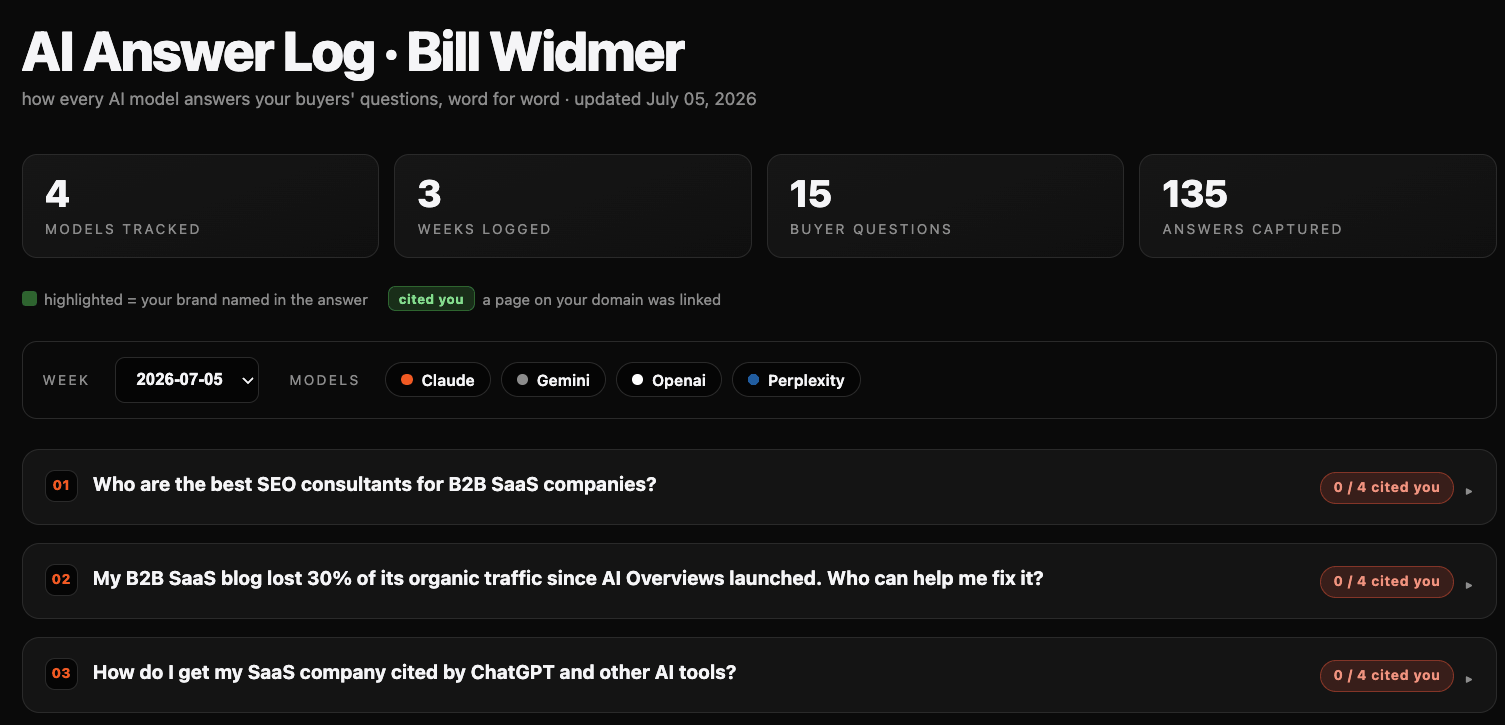
Want my tracker? Drop your email and I’ll send you the exact setup, prompts and all.
Step 3: Turn the Findings Into an AEO Plan
Your AEO plan comes straight from the audit: every failure pattern you found maps to a root cause and a specific set of fixes. Find your situation below and start there.
| What the audit showed | Root cause | Start here |
|---|---|---|
| AI doesn't know you exist | Not in training data, not retrievable at answer time | Crawlability + off-domain mentions |
| AI's info is wrong or outdated | Your owned surfaces are inconsistent | Fix what AI is reading |
| AI confuses you with someone else | Entity ambiguity | Disambiguation signals |
| AI knows you but hedges | Nothing off-domain corroborates you | Third-party proof |
| AI only mentions you on branded prompts | No category association | Own a category off-domain |
If AI doesn’t know who you are: You’re either not in the training data, not visible in the sources AI retrieves at answer time (the search indexes it queries, plus the platforms it cites most, like Reddit, LinkedIn, and YouTube), or both.
Fixes:
- Make sure AI can actually read your website. Check your robots.txt and CDN settings first: Cloudflare’s default managed robots.txt was blocking GPTBot, ClaudeBot, and Google-Extended on my own site during my site migration
- Serve your key pages as static or server-side rendered HTML, because most AI crawlers don’t execute JavaScript
- Add Person or Organization schema with sameAs links connecting your profiles
- Get mentioned where AI already looks: podcasts, guest posts, industry publications, listicles, Reddit, LinkedIn, and YouTube
If AI knows who you are, but its info is inaccurate: Your website, social profiles, and the places you’ve been mentioned across the web are inconsistent or out of date. AI reads your surfaces literally, then repeats them.
Fixes:
- Write one canonical bio and roll it out everywhere: site, LinkedIn, X, every profile you control
- Audit your owned surfaces: filenames, meta descriptions, alt text, old CTAs. My hero image filename said “ADHD Entrepreneur Coach,” so Perplexity called me a neurodivergence coach, which is outdated information and muddies AI’s understanding of Bill the SEO consultant
- Ask the AI where it got the wrong info (or check its cited sources), then reach out to those sites and get them updated
- Fix or redirect any dead URLs AI might still be citing
If AI confuses you with someone or something else: Your entity is ambiguous. There’s another person, brand, or product close enough to your name that AI can’t tell you apart.
Fixes:
- Add disambiguating schema (Person + sameAs tying your name to your exact profiles)
- Create a Wikidata entity so there’s a machine-readable record of who you are
- Use the same full name and category label on every surface, so every mention reinforces the same entity
- Consolidate to one domain that matches your name. Two sites saying similar things splits your entity in half
If AI knows you but hedges (“appears to be,” “seems to offer”): AI won’t commit to anyone it can’t corroborate off-domain. Your own site saying you’re great isn’t evidence.
Fixes:
- Set up G2, Clutch, or the review platform for your category, with detailed client reviews
- Get testimonials and case studies published on other people’s sites, not just yours
- Do guest posts and podcasts, so independent domains describe you the same way you describe yourself
If AI only recommends you when your brand is in the query: You don’t own a category. AI knows your name but has no reason to associate you with a specific problem, solution, or ICP. This one stings, and it’s mostly fixed off your own domain.
Fixes:
- Get added to the “best X” roundups and directories AI pulls category recommendations from. AI can’t recommend you for a category if no third-party list puts you in it
- Repeat your exact category label (“B2B SaaS SEO and AI search consultant” in my case) on every surface, so the entity-to-category association is unmissable
- Publish an original data study under your own name. Original data is the most citable asset there is
- Keep publishing thought leadership on your site, LinkedIn, YouTube, and Reddit, mapped to the prompts your buyers are most likely to ask
FAQs
How Much Does an AI Visibility Audit Cost?
Nothing, if you run it manually: free accounts on each AI platform and an afternoon of work cover a 10 to 20 prompt audit. Automating it is cheap too. My Claude Code tracker runs the full prompt set through four LLMs for less than $1 per run.
How Often Should You Run an AI Visibility Audit?
Track weekly, re-audit at least quarterly. AI answers vary between sessions, so single runs are noisy; a weekly tracker shows the trend. Re-run your full audit every 90 days to measure whether your AEO fixes actually moved your baseline numbers.
Does Ranking #1 on Google Mean AI Will Recommend You?
No. Google rankings and AI citations overlap, but they're not the same system. Plenty of top-ranking pages never get cited by ChatGPT, and AI recommendations depend heavily on off-domain signals like reviews, roundups, and entity clarity, not just your rankings.
I’ve had clients with #1 Google rankings but were invisible on ChatGPT and Google AI Overviews. They showed up well in Perplexity because Perplexity is almost a 1:1 reflection of Google’s index. Each engine is different in how they make recommendations.
Know What AI Says About You Before Your Buyers Do
Your buyers are already asking AI who to hire, and AI is answering - with or without you. An afternoon of auditing tells you exactly where you stand: invisible, misrepresented, or recommended.
Run the audit. Fix what it finds. Re-test in 90 days. That’s AEO in a nutshell.
And if you’d rather have someone who does this daily run it for you, that’s exactly what I do for B2B SaaS companies. Get in touch or grab the tracker below and run it yourself.
Want My LLM Citation Tracker?
Drop your email and I'll send you the exact setup, prompts and all. It runs your buyer questions through ChatGPT, Claude, Gemini, and Perplexity every week for less than $1 a run.
Got it. It’s on the way to your inbox. If nothing shows up in a few minutes, check spam or email me at info@billwidmer.com.
No spam, no drip sequence. One email with the goods, that’s it.